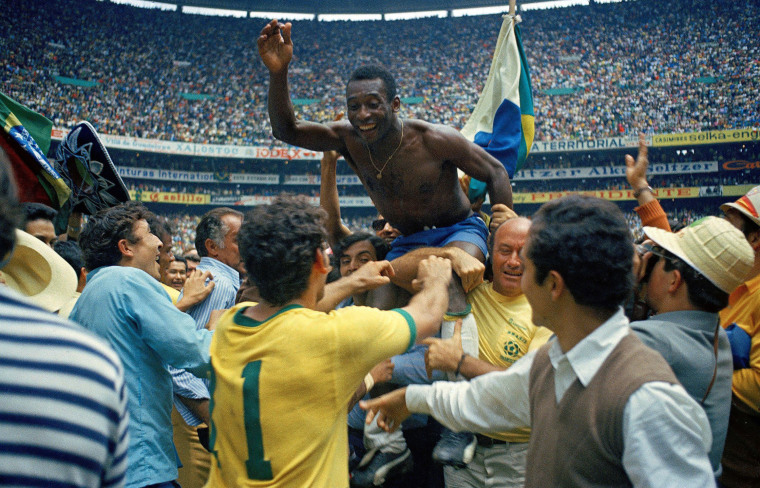
Brazil 1970: Joga Bonito
There is a version of football that exists only in memory and in grainy colour footage shot at altitude in Guadalajara and Mexico City — a version so luminous it has made every subsequent golden age feel provisional. The 1970 Brazil side did not merely win the World Cup; they provided the standard against which everything else would be measured and, invariably, found wanting.
The formation was officially a 4-3-3, but that schematic undersells the anarchy of genius at work. Pelé dropped deep and Tostão ghosted infield; Rivelino cut from the left with a left foot that seemed designed for a different, more beautiful planet; Jairzinho ran at defenders with the directness of a man who had calculated, and discarded, all the alternatives. In midfield, Gérson conducted the tempo with the authority of a maestro conducting an orchestra that had already memorised the score. Behind them, Clodoaldo recycled and destroyed, freeing the others to create.
What made the side philosophically distinct was its refusal to defend with fear. Even their defensive organisation felt offensive in spirit — as though conceding a goal would simply give them the opportunity to score two more. Félix in goal was porous by elite standards, but the calculus never mattered; this team's answer to defensive fragility was to make the other team feel they had no right to be on the same pitch. When Carlos Alberto received Pelé's perfectly weighted pass and hammered the fourth goal past the helpless Albertosi, it was less a football goal than a declaration of aesthetic principle.
Fifty-five years on, the 1970 squad still exerts a gravitational pull on how we imagine the game at its finest. Coaches study their patterns; philosophers use them as shorthand for beauty beyond utility. They did not just win the Jules Rimet Trophy in perpetuity — they won the argument about what football should aspire to be.
MATCH FOOTAGE
1970
Brazil 4–1 Italy
1970
Brazil 3–1 Uruguay
1970
Brazil 1–0 England
1970
West Germany 3–2 England (AET)